ONE:The struggle for ascendency proceeding, Walpole and his party secured the interest of the Duchess of Kendal, who always took care to side with that which she thought the stronger. Carteret and his party, on the other hand, secured the interest of the other mistress, the Countess of Darlington, and her sister, Madame de Platen. Whilst affairs were in this position, the two Secretaries of State, Townshend and Carteret, accompanied the king to Hanover. There came upon the tapis the question of a marriage between the Count St. Florentin, the son of La Vrilli¨¨re, the Secretary of State for France, and a daughter of Madame de Platen. Madame de Platen, however, demanded that La Vrilli¨¨re should be made a duke, so that in due course of time her daughter would be a duchess. George I. warmly seconded this demand; and, had Bolingbroke used his influence, there was little doubt that it would have been accomplished. But the French nobility raised a huge outcry against this honour being conferred on the family of La Vrilli¨¨re, which they deemed too obscure for such a dignity. Bolingbroke, however, was seeking his own objects through the other mistress, the Duchess of Kendal; and, notwithstanding the repulse which he had received from Walpole, he still calculated that his power would prevail, and he therefore smothered his personal vexation, and remained on the side of the Duchess of Kendal and Walpole, leaving Carteret and his allies, the Platens, to fight their own battle.
ONE:As soon as five or six thousand of his troops were landed, Buonaparte commenced his march on Alexandria. The Turks manned the walls, and resisted furiously, incensed at this invasion by a Power with which they were nominally at peace. But the walls were ruinous; the French forced their way over several breaches, and commenced an indiscriminate massacre. The place was abandoned to pillage for four hours. As the Mamelukes were hated by the Arabs and the Copts, and were the military mercenaries of the country, chiefly recruited from Georgia and Circassia, Buonaparte determined to destroy them. He considered that he should thus rid himself of the only formidable power in Egypt, and at the same time conciliate the Bedouins and Fellahs. On the 7th of July he set out on his march for Cairo with his whole force. He marched up the bank of the Nile, but at such a distance as to prevent the soldiers from getting any water to quench their burning thirst. It was all that Buonaparte could do to keep his troops in subordination. For fourteen days this melancholy march was continued, when they came at once in sight of the Pyramids, not far distant from Cairo, and of the army of the Mamelukes, drawn up across their way, headed by Murad Bey. This force consisted of five thousand cavalry¡ªMamelukes, mounted on the finest Arabian horses in the world, trained to obey the slightest touch of the rein, to advance, wheel, or fly with wonderful rapidity. The riders were all fine men, armed with sabres, pistols, and blunderbusses of the best English workmanship. They were deemed invincible and were ruthlessly cruel. They presented in appearance the finest body of cavalry in the world, the plumes of their turbans waving in the air, and their arms glittering in the sun. There were, moreover, twenty thousand infantry lying in a slightly-entrenched camp on their right;[467] but these were a mere rabble¡ªfellaheen, or, in other words, peasantry, brought from their fields, and armed with matchlocks. They had forty pieces of cannon to defend the camp, but these had no carriages, being mounted on clumsy wooden frames. Buonaparte drew up his army so as to keep out of gunshot of the camp, and to deal only with the cavalry first. He formed his troops into squares to resist the onslaught of the cavalry; and as he saw the Mamelukes come on, he called to his men, "From yonder Pyramids twenty centuries behold your actions!" The Mamelukes came thundering on like a whirlwind, and sending before them the most horrible yells. Murad Bey said he would cut up the French like gourds. One of the French squares was thrown into confusion, but it recovered itself, and the battle was instantly a scene of the most desperate fury. The Mamelukes fought like demons; but, finding that they could not break the French ranks, whilst they and their horses were mown down by musketry and artillery, in despair they flung their pistols at their foes, backed their horses up to them to break them by kicking, and finding all unavailing, fled. Such as were left wounded on the ground crept forward to cut at the legs of the French soldiers. Both cavalry and infantry then, by swimming their horses, or in boats, attempted to cross the Nile, but the greater part were drowned in the attempt. Murad Bey, with the residue of his Mamelukes, escaped into Upper Egypt.On the 6th of May Burke had brought forward a measure for the benefit of his long-oppressed country, to the effect that Ireland should enjoy the privilege of exporting its manufactures, woollen cloths and woollens excepted, and of importing from the coast of Africa and other foreign settlements all goods that it required, except indigo and tobacco. The Irish were to have the additional privilege of sending to England duty-free, cotton-yarns, sail-cloth, and cordage. Parliament, for once, looked on these demands with favour. They recollected that the Americans had endeavoured to excite disaffection amongst the Irish by reference to the unjust restrictions on their commerce by the selfishness of England, and they felt the loss of the American trade, and were willing to encourage commerce in some other direction. Lord Nugent co-operated with Burke in this endeavour. But the lynx-eyed avarice of the English merchants was instantly up in arms. During the Easter recess, a host of petitions was[254] got up against this just concession. The city of Bristol, which was represented by Burke, threatened to dismiss him at the next election, if he persisted in this attempt to extend commercial justice to Ireland; but Burke told them that he must leave that to them; for himself, he must advocate free trade, which, if they once tried it, they would find far more advantageous than monopoly. They kept their word, and threw him out for his independence. At the same time, the English merchants, as they had always done before by Ireland, triumphed to a great extent. They demanded to be heard in Committee by counsel, and the Bills were shorn down to the least possible degree of benefit.
TWO:"Yes, ye have one!"
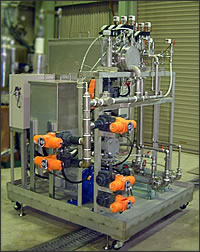
A hydrocyclone (liquid cyclone) injects treatment solution into stationary equipment to perform separation, classification, and concentration, and is an innovative separator with a very simple structure and no drive unit.
Structure of a hydrocyclone (liquid cyclone)
A suspension containing fine particles of several micrometers or more is supplied to a cylindrical container circumferentially at high speed. And as a result it starts to rotate and a centrifugal force is generated. At this time a gravitational acceleration of several tens of thousands of G is generated in the circumferential direction, and thus leading to fast sedimentation and concentration of the fine particles. The separated concentration can be freely selected by changing the supply rate (supply pressure and flow rate) and the flow ratio of the outlet. Our hydrocyclone (liquid cyclone) was designed and manufactured to classify and concentrate fine particles, and so has a small element.
THREE:Sir Robert Peel did all in his power to form out of the materials at his disposal a Ministry that should command the confidence of the country. On the 16th he issued an address to his constituents at Tamworth, in which he announced the policy that should guide the new Government. He declared his intention to correct all proved abuses and real grievances; to preserve peace at home and abroad; to resist the secularisation of Church property in any part of the United Kingdom; to fulfil existing engagements with Foreign Powers; to observe a strict economy in the public expenditure; and promised an impartial consideration of what was due to all interests, agricultural, manufacturing, and commercial. He said:¡ª"With regard to the Reform Bill itself, I accept it as a final and irrevocable settlement of a great[379] constitutional question; a settlement which no friend to the peace and welfare of the country would attempt to disturb either by direct or insidious means. I will carry out its intentions, supposing those to imply a careful review of old institutions, undertaken in a friendly spirit, and with a purpose of improvement."
Equipment costs can be reduced.
Operating costs can be reduced.
Maintenance costs can be reduced.
Any change in raw material and product can be easily addressed.
Large amounts can be treated in a small area.
Separation and cleaning are easy because of the simple structure.
Simplified control
This equipment can be operated in synchronization with external devices.
Alarm and interlock mechanism.
THREE:
Classification and concentration for the manufacture of inorganic powder materials
Classification of ceramic materials
Removal of fine particles, including iron powder
Removal of fine particles from pigments
Removal of fine organic particles from solvents
Separation of starch and yeast
Removal of fine particles from high-temperature strong acid solutions
Removal of fine particles from low-temperature solutions